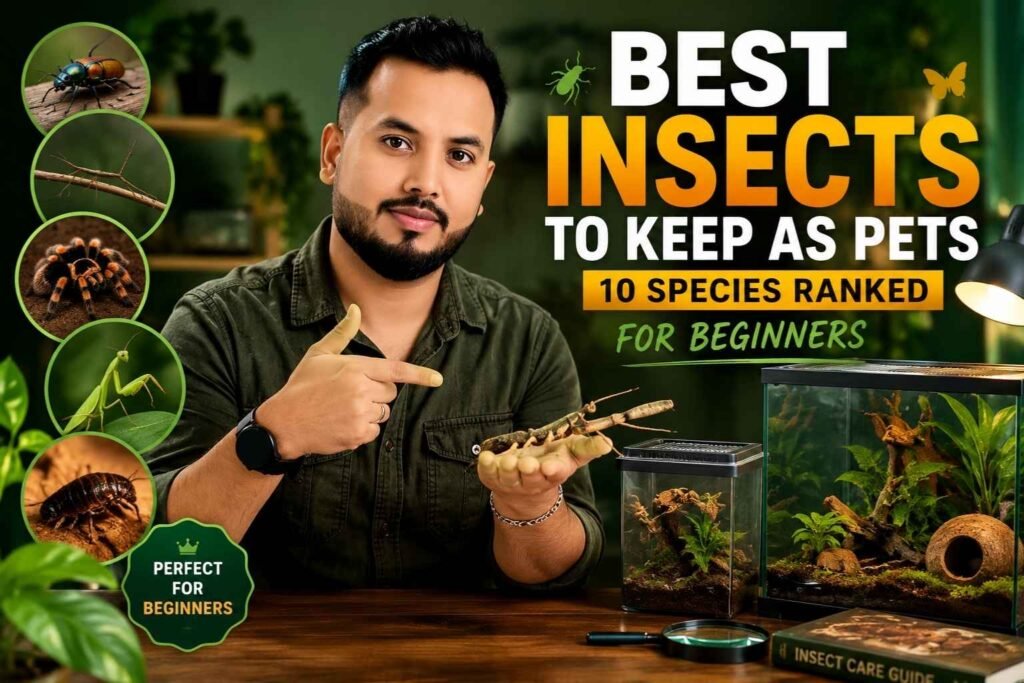
I used to think bugs were just pests until a tiny praying mantis stole my heart last summer. My tiny apartment felt so empty, but raising that little guy completely changed how I see nature. After years of keeping them, I can confidently say bugs make amazing, low-stress companions for busy people. Let’s look at the best insects to keep as pets so you can find your own perfect little buddy today.
At A Glance
- The best insects to keep as pets for beginners are Madagascar hissing cockroaches, discoid roaches, and Indian stick insects, because they tolerate small care mistakes and don’t bite or sting.
- A real “low maintenance” pet bug still needs a 5-minute daily check. Skip that check for a week and you can lose the whole group.
- Social species like ants live in a colony and need a totally different setup than solitary bugs like a praying mantis, which will kill and eat its own kind if housed with another mantis.
- Some “easy” species are illegal to ship or own in certain states or countries. Always check your local rules before you buy.
- I rank all 10 species below from easiest to most involved, with a full comparison table, so you can pick a bug that fits your time, space, and budget.
What Makes an Insect a Good Beginner Pet?
A good beginner bug is one that forgives small mistakes. It does not die if the room gets a few degrees too cold for one night. It does not need live food every day. It does not bite, sting, or try to escape every time you open the lid.
I’ve kept bugs for over 15 years, in everything from a single shoebox tub on a college desk to a back room with dozens of bins stacked on shelves. The species on this list are the ones I’d hand to a total beginner without worry. The ones I leave off are the ones that punish you fast for a missed water change or a cold night.
Three things decide if a bug is “beginner-friendly”:
Lifespan and growth speed. A bug that lives one to five years gives you time to learn its habits. A bug that lives two weeks does not.
Tolerance for swings in heat and moisture. Beginners will get the temperature wrong sometimes. The best starter bugs shrug this off. The worst ones die from it.
Handling and escape risk. Some bugs are calm enough to hold. Some will bite, spray, or vanish into your walls the moment the lid comes off. Beginners want the calm ones.
The “Low Maintenance” Myth: Why Every Insect Still Needs a Daily Check
Pet stores love to say bugs are “low maintenance.” That phrase causes more dead colonies than any other piece of advice I’ve heard.
Here’s the truth: insects need less daily work than a dog, but they still need daily attention. I call this the 5-minute daily check, and it’s the single habit that separates keepers who succeed from keepers who lose their whole colony in a week.
The check takes five minutes and covers four things:
- Water. Is the water dish, water gel, or misted surface still wet? Bugs dehydrate fast in a dry room, and a dry tank can kill a colony in days, not weeks.
- Food. Has yesterday’s food gone moldy? Rotting fruit or veggies breed mold that can wipe out an entire roach or stick insect group (Amateur Entomologists’ Society, 2024).
- Temperature. Is the heat mat or room still in range? A 10-degree swing overnight is the most common beginner mistake on this list.
- Behavior. Are the bugs moving, eating, and acting normal? A sudden change, like all the roaches piling in one corner, usually means something is wrong with heat or humidity.
Skip this check for a week and small problems become big ones. Mold spreads. Water dishes dry out. A heat mat that slipped off its thermostat cooks half a colony before you notice. None of this happens if you spend five minutes a day looking.
Species Comparison Table: All 10 Ranked Insects at a Glance
| Rank | Species | Care Difficulty | Lifespan | Enclosure Size | Starting Cost | Temperament/Upkeep |
|---|---|---|---|---|---|---|
| 1 | Madagascar Hissing Cockroach | Very Easy | 2-5 years | 10-gallon tub (small group) | $20-40 | Docile, handleable, tolerates wide temperature range |
| 2 | Discoid Roach | Very Easy | 10-26 months | 10-gallon tub | $15-30 | Calm, cannot climb glass, low odor |
| 3 | Indian Stick Insect | Easy | 9-12 months | Tall mesh cage, 12+ inches | $15-35 | Calm, slow-moving, breeds on its own without a male |
| 4 | Giant African Millipede | Easy | 5-7 years | 10-gallon tub, more floor space than height | $20-40 | Slow, gentle, never bites or stings |
| 5 | Dubia Roach | Easy | 1-1.5 years | 10-gallon tub | $20-35 | Cannot climb smooth surfaces, quiet, odorless |
| 6 | Giant Asian Mantis | Moderate | About 1 year | Tall, narrow cage, 3x body length | $25-50 | Solitary, must live alone, needs live food |
| 7 | Death’s Head Cockroach | Moderate | 1-2 years | 10-gallon tub | $20-35 | Calm but startles easily, needs higher humidity |
| 8 | Orchid Mantis | Moderate | About 6-8 months | Tall, humid mesh or screen cage | $30-60 | Beautiful but delicate, needs precise humidity |
| 9 | Black Carpenter Ant Colony | Involved | Workers live years, queen can live over a decade | Formicarium plus outworld | $40-100+ | Social colony, slow startup, needs patience |
| 10 | Giant Burrowing Cockroach | Involved | 5-10 years | Deep substrate tub, burrowing species | $40-80 | Heavy-bodied burrower, needs deep substrate and warmth |
The 10 Best Beginner Insects, Ranked
1. Madagascar Hissing Cockroach — The Easiest Starter Bug, Full Stop
This is the bug I hand to total beginners first. The Madagascar hissing cockroach (Gromphadorhina portentosa) is large, calm, and almost impossible to kill with normal care.
Temperament: Docile enough to hold. They do not bite. The hiss, which gives them their name, is a defense sound made by pushing air through small holes on their sides, not through their mouth (Oklahoma State University Extension, 2017). It’s startling the first time you hear it and harmless every time after.
Enclosure: A 10-gallon plastic tub with a secure, tight-fitting lid works for a starter group of five to ten roaches. They climb glass and plastic with ease, so the lid must seal well. Many keepers add a thin band of petroleum jelly just inside the rim as a backup against escapes.
Diet: They eat fruit, vegetables, grains, and a dry roach diet. In the wild they eat rotting plant matter on the forest floor, so they’re not picky.
Lifespan: Two to five years in captivity, which is long for an insect pet (Oklahoma State University Extension, 2017).
Best for: First-time keepers, families with curious kids, and anyone who wants a bug that survives small care mistakes. My first hisser colony survived a two-week vacation with nothing but a full water gel dish and a pile of carrots. I came home expecting disaster and found a thriving group instead. That single experience is why this species sits at the top of every beginner list I write.
One mistake to avoid: never handle a roach that has just molted. Right after shedding, its new shell is soft and pale white. Squeezing it at this stage can cause real injury. Wait a few hours until the shell hardens and darkens before picking it up.
2. Discoid Roach — The Quiet, Climb-Proof Beginner Roach
If you want a roach but don’t want anything that can climb your walls, the discoid roach (Blaberus discoidalis) is the answer.
Temperament: Calm and slow-moving. Unlike hissers, discoids cannot climb smooth surfaces like glass or plastic, which makes escapes far less likely (Invertebrays Care Guide, 2023). They also stay silent and produce almost no odor, which matters if your tub lives in a bedroom.
Enclosure: A 10-gallon tub with a secure lid. Since they can’t climb glass, you don’t need the petroleum jelly trick, though a snug lid is still smart.
Diet: Fruit, vegetables, grains, and a little extra protein from dog or cat food helps them thrive. Remove uneaten produce within a day or two to stop mold.
Lifespan: Males typically live ten to twelve months, while females often live eighteen to twenty-six months (Crazy Plants Crazy Critters Care Sheet, 2019).
Best for: Anyone in an apartment who wants a low-odor, low-escape-risk roach. Discoids are also legal in places that restrict other roach species, which makes them a popular substitute where local rules are stricter (Ready Reptile Feeders Care Guide, 2022).
One mistake to avoid: letting humidity climb too high. Mold wipes out discoid groups faster than almost any other problem. Keep humidity in the 40 to 60 percent range and pull out any food that’s starting to turn.
3. Indian Stick Insect — The Calmest Bug You Can Hold
The Indian stick insect (Carausius morosus) looks exactly like its name says: a thin, brown, twig-shaped bug with no interest in biting or running.
Temperament: About as calm as an insect gets. They move slowly, rarely react to handling, and their main defense is freezing in place to look like a stick.
Enclosure: A tall mesh or screened cage, at least three times the insect’s body length in height, gives them room to molt properly. A cage around 12 inches tall suits a small group comfortably. Substrate isn’t needed and can actually cause mold problems, so most keepers skip it.
Diet: Bramble, ivy, oak, privet, or rose leaves. This is the one catch with this species: you need a steady supply of fresh leaves, which means either a garden nearby or a reliable source.
Lifespan: About nine months to a year (Stick Insect Advice Care Guide, 2024).
Best for: Anyone who wants the calmest possible bug to observe and occasionally hold. One quirk worth knowing up front: females reproduce through parthenogenesis, meaning they lay fertile eggs without ever mating with a male (RSPCA Invertebrate Care Sheet, 2024). A single female can leave you with a surprise second generation if you’re not prepared to deal with eggs.
One mistake to avoid: running out of food plants. Unlike a roach, a stick insect won’t switch to a pellet diet when the leaves run low. Line up a steady leaf source before you bring one home.
4. Giant African Millipede — Slow, Gentle, and Built to Forgive Mistakes
The giant African millipede isn’t technically an insect (it’s a myriapod), but it earns a spot on almost every beginner bug list because it is genuinely that easy.
Temperament: About as harmless as an invertebrate gets. It does not bite or sting. If startled, it may curl into a tight coil and release a mild defensive fluid, which can irritate skin or eyes, so the main rule is simple: wash your hands after handling (San Diego Zoo Wildlife Alliance, 2023).
Enclosure: A 10-gallon tub with several inches of moist substrate for burrowing matters more than height here. These animals spend a lot of time underground, so floor space and substrate depth beat vertical space.
Diet: Rotting fruit, vegetables, and a calcium source like cuttlebone, since their hard exoskeleton needs calcium to stay strong through molts.
Lifespan: Five to seven years with good care, which is exceptional for an invertebrate this easy to keep.
Best for: Beginners who want a calm, slow pet that does well even with an imperfect setup. They’re forgiving of small humidity swings as long as the substrate never fully dries out.
One mistake to avoid: letting the substrate dry out completely. A millipede that dries out can die fast, since its body loses water quickly without enough moisture in the soil around it.
5. Dubia Roach — The Reptile Keeper’s Favorite Crossover Pet
The Dubia roach (Blaptica dubia) is best known as feeder food for reptiles, but plenty of keepers raise a colony purely to watch and care for.
Temperament: Calm and slow. Like discoids, Dubias cannot climb smooth glass or plastic, which keeps escape risk low.
Enclosure: A 10-gallon tub with egg crate stacked for extra floor space works well for a starter colony.
Diet: Roach chow, vegetable scraps, and fruit in small amounts. Avoid citrus in large quantities, since it can affect breeding in some setups.
Lifespan: Around one to one and a half years per generation, though a well-fed colony keeps producing new roaches continuously.
Best for: Anyone who already keeps reptiles and wants a sustainable feeder colony, or anyone who just likes the idea of a quiet, low-odor roach group that requires almost no daily fuss beyond food and water.
One mistake to avoid: overcrowding the tub. A packed colony breeds disease and stress faster than a colony with room to spread out. Upgrade tub size as the group grows.
6. Giant Asian Mantis — A Beautiful, Solitary Predator
The Giant Asian mantis (Hierodula species) and its cousin the Chinese mantis (Tenodera sinensis) are stunning to watch hunt, but they come with a hard rule beginners must follow.
Temperament: Solitary and predatory. Mantises are cannibalistic. Keep more than one in the same enclosure and you will likely lose one to the other (PetHelpful Mantis Care Guide, 2023).
Enclosure: A tall, narrow cage, at least three times the mantis’s body length in height, since mantises spend most of their time hanging and need room to molt without touching the ground.
Diet: Live food only. Crickets, flies, and other small live insects, offered with tweezers or released directly into the enclosure.
Lifespan: About one year for most commonly kept species.
Best for: Keepers who want to watch real predatory behavior up close and don’t mind handling live feeder insects regularly. This is a step up from the first five species because feeding means sourcing and storing live food, not just dropping in fruit scraps.
One mistake to avoid: ever housing two mantises together past their earliest nymph stage. Young hatchlings tolerate group housing briefly, but once they molt into their second stage, cannibalism risk climbs fast (Amateur Entomologists’ Society, 2024).
7. Death’s Head Cockroach — The Striking Beginner-Adjacent Roach
Blaberus craniifer, named for the skull-like marking on its back, is calm like other Blaberus roaches but asks for slightly more attention to humidity.
Temperament: Calm and rarely aggressive, though they startle and scatter quickly when disturbed, more so than hissers or discoids.
Enclosure: A 10-gallon tub with secure ventilation. They tolerate glass climbing less than hissers but still benefit from a snug lid.
Diet: Standard roach diet of fruit, vegetables, grains, and protein.
Lifespan: One to two years typically.
Best for: Keepers who’ve already succeeded with a hisser or discoid colony and want a more visually striking species without a big jump in difficulty.
One mistake to avoid: keeping humidity too low. This species wants slightly higher humidity than discoids, and a too-dry tub leads to molting problems over time.
8. Orchid Mantis — Gorgeous, but Not Forgiving
The orchid mantis (Hymenopus coronatus) is the bug people post on social media. It’s also the first species on this list I’d tell a true beginner to wait on.
Temperament: Solitary, like all mantises, and beautiful to watch as it mimics a flower to ambush prey.
Enclosure: A tall, well-ventilated cage with high humidity, misted regularly. This species is far less tolerant of dry conditions than the Giant Asian mantis.
Diet: Live food, same as other mantises, but orchid mantis nymphs are tiny and need very small prey like fruit flies early on.
Lifespan: Around six to eight months as an adult, shorter than most other species here.
Best for: Keepers who’ve already raised at least one easier mantis species and understand live food sourcing, humidity control, and the work of feeding tiny nymphs.
One mistake to avoid: buying one as a true first bug. The combination of high humidity needs, tiny prey requirements at a young age, and general fragility makes this a poor pick for someone who has never kept any insect before.
9. Black Carpenter Ant Colony — A Totally Different Kind of Pet
Everything changes with this entry. A carpenter ant colony (Camponotus pennsylvanicus) is not one pet, it’s a society, and caring for it means caring for dozens or hundreds of individuals as a single unit.
Temperament: Not applicable in the usual sense. Individual ants matter less than colony health. Workers forage, tend brood, and defend the nest as a group.
Enclosure: A formicarium, a specialized ant nest, connected to an “outworld” foraging area by tubing. Beginners typically start a single queen in a small test tube setup before moving the growing colony into a full formicarium once she has her first workers.
Diet: Sugar water or nectar, plus protein from small insects like fruit flies or crushed mealworms.
Lifespan: Workers live months to a few years. Queens of long-lived species can live well over a decade (The Ant Vault Care Guide, 2024).
Best for: Patient keepers who enjoy long-term projects more than instant results. Building a colony from a single queen to a mature group takes about a year of steady care (AntsCanada, 2024).
One mistake to avoid: shipping or buying queen ants without checking the law first. In the United States, federal regulations restrict shipping live queen ants of most species across state lines without a permit, which is exactly why most toy ant farms sold in stores never include a live queen (Wikipedia, Ant-keeping, 2026). Always confirm your state and country’s rules before ordering live ants. This applies far beyond ants too; many states and countries restrict or ban specific insect species, so a quick check with your local department of agriculture or wildlife agency before any purchase saves you real legal trouble later.
10. Giant Burrowing Cockroach — The Heavyweight for Committed Keepers
The Giant burrowing cockroach (Macropanesthia rhinoceros), sometimes called the rhinoceros cockroach, is the most involved species on this list, and also one of the longest-lived insects you can own.
Temperament: Slow, heavy-bodied, and almost entirely focused on burrowing rather than climbing or fleeing. It’s about as far from a “creepy fast bug” as a cockroach gets.
Enclosure: A deep tub, at least six to eight inches of substrate, since this species spends most of its life underground and needs real digging room. Floor space and substrate depth both matter more here than for any other species on this list.
Diet: Dry leaf litter and bark in the wild; in captivity, a mix of dry leaves, bark, and occasional vegetable matter works well.
Lifespan: Five to ten years, among the longest of any commonly kept insect.
Best for: Keepers who already have experience with substrate-based setups and want a true long-term commitment. This is not a starter bug, but it’s a fantastic next step once a beginner has built confidence with something like a hisser or millipede.
One mistake to avoid: underestimating substrate depth. A shallow tub leaves this species stressed and unable to express normal burrowing behavior, which shows up over time as poor health.
Solitary vs. Social Species: Two Completely Different Hobbies
Seven of the ten species above are solitary. One, the carpenter ant, is social. That single difference changes almost everything about how you keep them.
A solitary insect like a mantis, stick insect, or roach lives its life as an individual. You watch one animal, or a loose group of animals that don’t depend on each other. If one roach dies, the rest of the group carries on the same as before.
A social species like an ant colony works as one unit. Workers, brood, and the queen depend on each other completely. You’re not caring for one ant. You’re caring for an entire system, and the health of that system depends on the queen surviving and the colony growing at a steady pace.
This changes the observation value too. A solitary bug shows you individual behavior: a mantis striking at prey, a roach exploring its tub. A colony shows you group behavior: foraging trails, brood care, and the slow architecture of tunnels spreading through a nest. Both are fascinating. They’re just fascinating in different ways, and they ask for very different levels of long-term commitment.
Climate-Controlled vs. Room-Temperature Species: What Beginners Get Wrong
Some bugs on this list do fine at normal room temperature. Others need a heat mat and steady warmth to thrive. Mixing these up is one of the most common beginner mistakes I see.
Room-temperature species include the Indian stick insect, which does well between 68 and 75°F without any extra heating (Exotic Pets UK Care Guide, 2023). Most temperate ant species also handle room temperature fine, though some need a winter cooling period to mimic natural seasons.
Heat-loving species include the Madagascar hissing cockroach, discoid roach, and Dubia roach, all of which grow and breed fastest in the mid-70s to mid-80s°F range, even though they can survive cooler temperatures without breeding well (Josh’s Frogs Care Guide, 2023).
The beginner mistake isn’t picking the wrong category. It’s assuming every bug fits the same category. A heat mat that works perfectly for a roach tub can overheat a stick insect cage. A room that’s comfortable for a mantis might be too cool for a Dubia colony to breed. Match the heating setup to the specific species, not to a general idea of “bugs need warmth.”
How to Set Up and Read a Basic Thermometer and Hygrometer
Every enclosure on this list benefits from one simple tool: a combined thermometer and hygrometer, the small gauge that reads both temperature and humidity.
Placement matters more than the gauge itself. Put it at substrate level, not stuck to the lid. Heat rises and humidity tends to settle, so a gauge near the top of the tank often reads warmer and drier than what your bugs actually experience at ground level.
Read it daily during your 5-minute check. You’re not just confirming the number looks right once. You’re watching for trends. A humidity reading that’s been slowly climbing over a week often means mold is starting to build before you can see it.
The substrate moisture test catches problems the gauge misses. Push one finger about an inch into the substrate. If it feels bone-dry at that depth even though the surface looks damp, your enclosure is drying out from the bottom up, a problem a hygrometer sitting near the top won’t always catch in time. If it feels soaking wet and clumps together, you’re overwatering, which invites mold fast.
Problem zones show up in corners and under hides. Mold and excess moisture tend to start in the spots with the least airflow, usually a corner or underneath a hide or piece of bark. Check those spots specifically during your daily look, not just the open floor area.
When to Start With a “Starter” Species vs. When to Wait
Not every species on this list belongs in a true beginner’s first tank. Here’s how I’d sort them.
Start here if this is your first bug ever: Madagascar hissing cockroach, discoid roach, Indian stick insect, or giant African millipede. All four tolerate mistakes, eat simple food, and don’t need live prey.
Move here after one successful year with an easier species: Dubia roach, Giant Asian mantis, or death’s head cockroach. These ask for slightly more precision, whether that’s sourcing live food or managing humidity a bit more closely.
Wait on these until you’ve built real experience: Orchid mantis, ant colony, or giant burrowing cockroach. Each of these punishes inexperience in a different way. The orchid mantis is fragile and needs tiny live prey from day one. The ant colony demands a full year of patience before it even looks like the colony you imagined. The giant burrowing cockroach needs deep substrate knowledge that most first-time keepers haven’t built yet.
This isn’t about skill so much as pattern recognition. After a year with an easy species, you’ll have already seen what a healthy bug looks like, what a stressed one looks like, and how fast small problems can spiral. That pattern recognition is worth more than any care sheet when you move up to a harder species.
Common Beginner Mistakes (and How to Fix Each One)
Mistake: Treating “low maintenance” as “no maintenance.” Even the easiest bug on this list needs the 5-minute daily check. Fix: set a daily reminder until the check becomes a habit, the same way you’d remember to feed a cat.
Mistake: Letting the enclosure dry out completely. This kills millipedes and stresses roaches fast. Fix: check substrate moisture with a finger test, not just a glance, since surfaces can look damp while the layer underneath is bone dry.
Mistake: Overcrowding a tub as the colony grows. A group that fit fine at 10 roaches gets stressed and disease-prone at 50. Fix: upgrade tub size before crowding becomes obvious, not after.
Mistake: Housing more than one mantis together past the earliest nymph stage. This leads to cannibalism, full stop. Fix: separate mantises into individual containers once they molt past their first instar.
Mistake: Skipping local legal research before buying. Some states and countries restrict or ban specific roach, ant, or even mantis species, and federal rules in the US restrict shipping live queen ants across state lines without a permit (Wikipedia, Ant-keeping, 2026). Fix: check your state’s department of agriculture or your country’s import rules before you order anything online, not after the package arrives.
Mistake: Buying a fragile species as a first bug. Orchid mantises and similar delicate species often die in inexperienced hands within weeks. Fix: start with one of the four true beginner species above and build experience first.
Mistake: Forgetting that stick insects need fresh leaves, not pellets. Running out of food plants is a fast way to lose a stick insect group. Fix: confirm you have a steady source of the right leaf type before bringing one home, not after.
My Personal Beginner Routine (and the Mistake That Taught Me the Most)
After 15 years of raising dozens of species, my actual daily routine is shorter than people expect. Here’s exactly what it looks like on a normal day.
Morning: a quick visual check on every tub, maybe 90 seconds per enclosure. I’m looking for movement, normal posture, and any obvious mess.
Once every two to three days: water and food refresh across roach and millipede tubs. Fresh produce goes in, old produce comes out, water gel or dishes get topped off.
Weekly: a deeper substrate check using the finger test described above, plus a quick wipe-down of any glass or acrylic that’s gotten grimy.
The mistake that taught me the most happened with my first hissing cockroach colony, the same one I mentioned earlier that survived a two-week vacation. What I didn’t mention is what happened right before that trip. I’d just moved the colony into a slightly bigger tub and, in the rush of packing for vacation, I forgot to check that the new lid actually sealed as tightly as the old one. I came home not to disaster, but to three hissers loose in a cardboard box across the room, having squeezed through a gap I hadn’t noticed.
Nothing bad happened. Hissers are slow, calm, and easy to recapture. But it taught me a rule I still follow today: every time you change an enclosure, even something as small as swapping a lid, treat it as a brand-new setup and double-check the seal before you walk away. The bugs that escape almost never cause real harm. The lesson is just that confidence in an old setup doesn’t transfer automatically to a new one.
Frequently Asked Questions
What is the easiest insect to keep as a pet?
The Madagascar hissing cockroach is widely considered the easiest. It tolerates a wide temperature range, eats almost any fruit or vegetable scrap, and is calm enough to handle without injury risk (Oklahoma State University Extension, 2017).
Do pet insects need to be fed every day?
Most do not. Roaches, millipedes, and stick insects can go a day or two between feedings without harm, as long as water stays available. Mantises specifically should not be fed daily, since overfeeding can cause health problems in some species.
Can I keep multiple insects together in one enclosure?
It depends entirely on the species. Roaches, millipedes, and most stick insects do well in groups. Mantises must be kept alone past their earliest nymph stage, since they will cannibalize each other.
How much does it cost to start keeping pet insects?
Most species on this list cost between $15 and $50 to start, including the insects themselves, a basic tub or cage, and substrate or food. Ant colonies and specialized species like the orchid mantis can run higher once you add a proper formicarium or humidity-controlled enclosure.
Are pet insects legal everywhere?
No. Some states and countries restrict or ban specific species, and US federal rules limit shipping live queen ants across state lines without a permit (Wikipedia, Ant-keeping, 2026). Always check your local department of agriculture or wildlife agency before ordering.
Do pet insects smell bad?
Most of the species on this list have little to no odor when kept clean. Discoid roaches and Dubia roaches are specifically known for being close to odorless (Invertebrays Care Guide, 2023). Smell usually signals mold or rotting food, not the insects themselves.
Can kids handle pet insects safely?
Many species here, especially Madagascar hissing cockroaches and Indian stick insects, are calm enough for supervised handling by kids. Always wash hands before and after handling any invertebrate, since they can carry bacteria like salmonella (Petco Care Guide, 2026).
What’s the biggest difference between keeping roaches and keeping an ant colony?
A roach group is a loose collection of individuals. An ant colony is a single social unit built around one queen, where the health of every worker depends on the colony functioning as a whole. Ants also take far longer to reach a “mature” stage, often around a year from a single queen to a working colony (AntsCanada, 2024).
Key Takeaways
- Madagascar hissing cockroaches, discoid roaches, and Indian stick insects are the three best true beginner species, since all three tolerate common care mistakes.
- The 5-minute daily check, covering water, food, temperature, and behavior, is the habit that separates successful keepers from failed colonies.
- Solitary species like mantises need to live alone past their earliest nymph stage. Social species like ants need an entirely different setup built around colony growth.
- Always check state and country laws before buying any insect species, especially ants, since shipping live queens across US state lines requires a federal permit in most cases.
- Build experience with an easy species for a full year before moving up to a fragile or demanding species like the orchid mantis or a full ant colony.